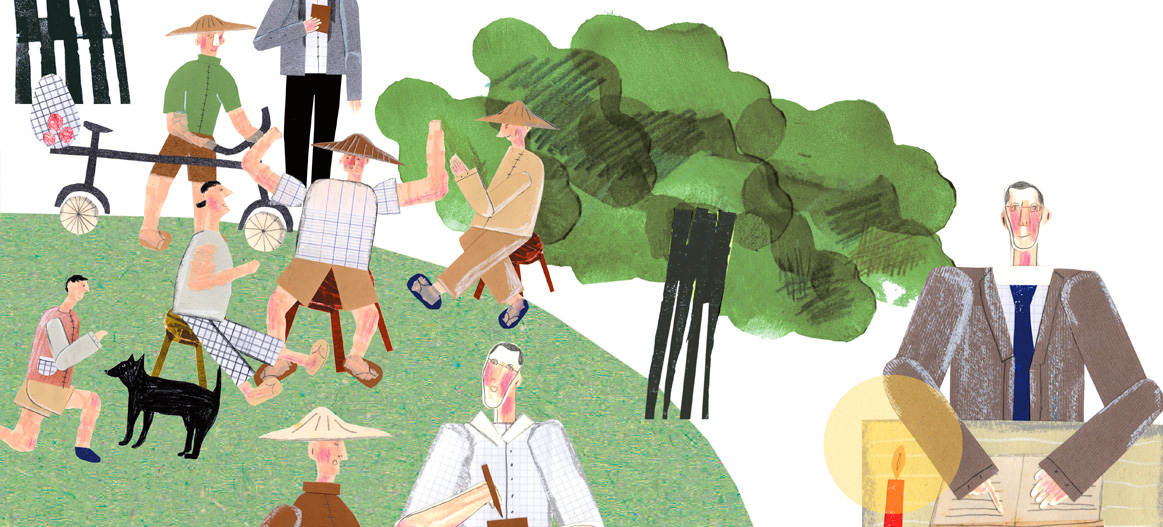
Campbell Naismith Moody is His Name - The Missionary Scholar from Scotland【Parent-Child Reading Guide】
點閱次數:74
A Creative Child Raised on Faith
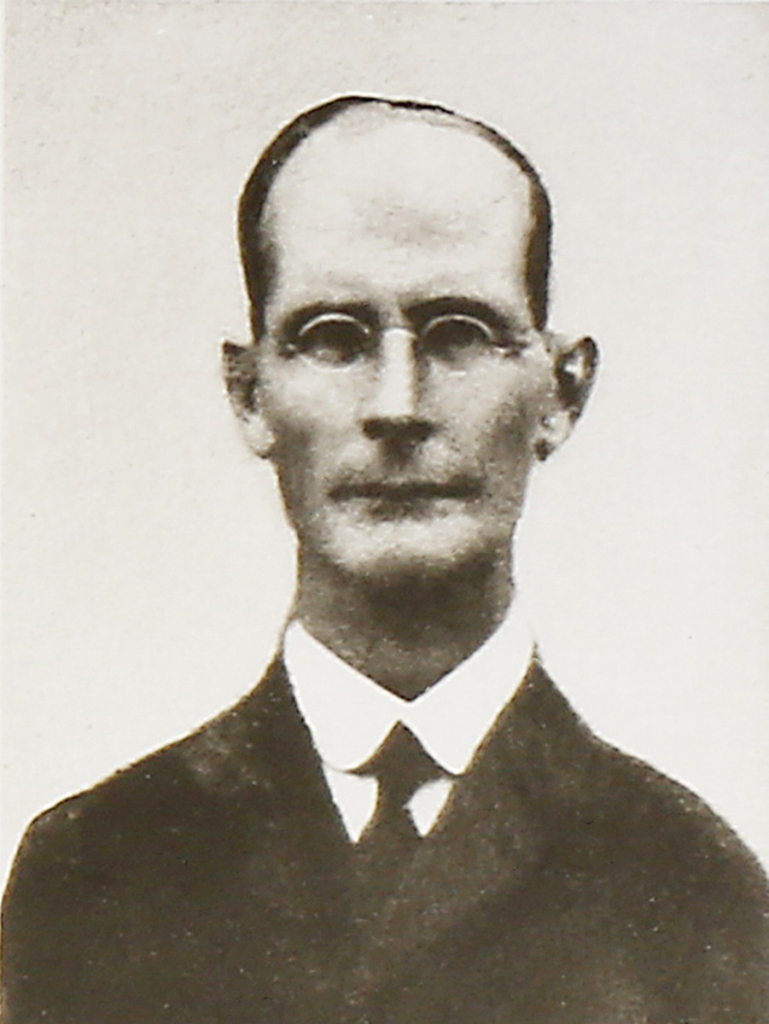
Rev. Campbell Naismith Moody was born in Lanarkshire, Scotland, on November 10, 1865. He was the fourth issue of Robert Moody, a legal secretary, and Mary Ewing Naismith.
Robert held frequent explicatory sessions of the Bible for the children and would, after each Sunday service, examine their comprehension of the week’s homily. In the evenings, Mary read to or practiced the Shorter Catechism with them. The family sometimes took turns picking hymns for singing in private worship. The children’s governesses were hand-picked by the rigorous Mary to be absolutely upright in character.
Moody himself was an inventive spirit always willing to roll up his sleeves. Calling on his playmates, he built a cabin and dug a tunnel ‘to Edinburgh’ in the garden of the family house. He made a working miniature engine, put together an automaton that would awake him, and even tied a giant kite to a sledge to see if he could ‘sail’ on land. He would grow to be brave and curious, rising to challenges with the hands-on approach he developed through play and experimentation.
A Student Orienting Himself by Diligence
Moody was admitted to the University of Glasgow at a mere 15. To get to his favorite Philosophy class on time, he would set off from home at half past six in the wintry morning and cross the coalfields on foot to reach the train station. In addition to apparent assiduity, Moody had won class-wide and best-essay awards to show for his aptitude as a wordsmith.
After being conferred the Master of Arts, Moody advanced to the Free Church College, a seminary where Thomas Martin Lindsay, the professor of church history, inspired him to look into how evangelism worked across different cultures. Moody’s later volumes, The Heathen Heart, The Saints of Formosa, and The King’s Guests, on his missionary observations in Taiwan, were the fruits of this intellectual pursuit.
He saw for himself the needs of the disadvantaged through off-term visits and preaching to impoverished communities, cultivating deep compassion and a sense of duty that would compel him to devote the better portion of his years to missionary work. He was also involved with society-supported projects, one of which—to establish a secondary school in Formosa—harbingered his eventual coming to Taiwan.
The Calling to Nations Faraway
The church employed Moody as soon as he graduated from the seminary. He made door-to-door calls, founded children’s choirs, and set up libraries. What was eating at his conscience, though, were the urban slums, and the fact that he should have been dwelling among the people he was to serve. Moody was ordained in the Free Church of Scotland in 1872. Despite his friends’ naivety that he was on an upward career trajectory given his abilities, he had an intense premonition that God was to guide him away from Scotland.
He was subsequently received into the Presbyterian Church of England and sent to Formosa, along with Rev. Andrew Bonar Nielson and Dr. David Landsborough III, with the latter of whom he would become lifelong confidants. On October 22, 1895, over a hundred friends and fellow churchgoers saw him off at the train station, singing the Rankin hymn God Be with You till We Meet Again. Three days hence, he embarked on SS Oceana for a new phase in life.
The Beginnings in Taiwan
Moody, Nielson, and Landsborough arrived in Tainan, Taiwan, on December 18, 1895. They lodged at the Rev. Thomas Barclay’s while being tutored in the Taiwanese language by Lîm Iàn-Sîn, a hsiu-tsai who had made it past the sub-provincial levels of Ching’s imperial examinations.
A year later, Moody and Landsborough trekked for four days to their chosen base of Changhua and began their medical-missionary work in and around that town and Taichung. The sultry climate had Moody suffering from chronic indigestion, and by no means could he recover in time due to the nature of village-to-village preaching. Worse still, he was never fully cured of malaria, a mosquito-borne disease that he repeatedly contracted, amidst all the anarchy following the Ching administration’s withdrawal in accordance with the Treaty of Bakan (Shimo-no-seki). On the road, Moody and Landsborough had only each other, and both of them played to their areas of expertise to progress in trying circumstances, leaving indelible footmarks in Central Taiwan where one leg was healthcare and the other, faith.
A Preaching Style That Pulled at Heartstrings
When he was about to start an open-air sermon, Moody had a bag of tricks by which to attract an audience. They included sounding the gong or horn and appealing to passers-by to find the ‘missing son’ of God. Of a child, he would inquire about the natural elements in his or her name, and thus lead those present to musings on whence one came to be and whither one was to go post mortem. The crowd’s imagination could easily be stoked by a child’s intuitive response to the latter question, be it the World of Darkness or the Underground Gaol. Then, at the right moment, Moody would bring out the themes of the gospel, shaping the vivid and resonating exchange thus far into a message of faith that was applicable in the day-to-day. Upon concluding the sermon, Moody would pack up, move on to the next village, and work until dusk, at which point he reluctantly began his walk back to Changhua.
During the more than twenty years Moody had served in Taiwan, he had travelled extensively throughout Changhua, Taichung, and Nantou (the three constituting Japanese-era Taichū Prefecture) and gone as far as Tainan and Penghu, founding or assisting in the rebuilding of over a score of congregations. He also served with writings in theology. Fifteen books in total Moody had penned, of which four were printed in Pe̍h-ōe-jī, the Roman-script writing system for Taiwanese. The multi-faceted nature of a missionary—original, persistent, and perceptive of cultural issues—is on full display when Moody’s legacy, tangible and intangible, is thoroughly assessed.
She Whose Worth Was Far Above Rubies
Moody had been married twice. Margaret Rintoul Findlay, his first wife, came to Taiwan in 1908, a mere couple of months into the union, but succumbed to illness in 1915. Margaret Christian Arthur, a missionary nurse, had been posted to Changhua Christian Hospital since 1919. She met and married Moody in 1921.
Towards Lux Aeterna, Formosa the Longed-for
Moody left Taiwan to convalesce in Scotland in 1924. He had every intention to return to the island, worrying that he had not been exemplary enough himself to dissuade some of the converts from stalling their spiritual advancement after rising in the social scale. “It is said that we have grafted Christianity—of the Occident, no less—onto the East,” he once wrote. “What frets me, though, is whether we have truly given them the kernel of the Word.”
In the early hours of February 28, 1940, Rev. Campbell Naismith Moody departed to meet the Maker. The 75-year-old was interred north of Glasgow at Campsie High Kirk; a memorial service was also held in Changhua the following June.
Throughout his life, Moody lived the faith and was unafraid to answer the calls of the times. His parents trained him to be a critical believer; the childhood interests fed back to his initiative and ingenuity; the academia imbued his industrious literature with profundity; the missionary journey required him to walk the land and walk with its people, to whom he preached and on whom he reflected in writing. Ever the humble and introspective servant to the Lord, even as he had to leave behind his ministry in the latter years, never was there a day that Moody satisfied himself with his fidelity to the gospel.
The story of Moody is a reminder to us that the model worth emulating is he who has traced true the way of the calling rather than achieved much. When one is willing to keep learning, dares try and care for others, and would elect to give even in troubled waters, their existence shall be a ray of light to shine on the world.